Fire Suppression for Critical Infrastructure and How It Works
Fire protection for critical infrastructure must do more than extinguish visible flames. Fire suppression for critical infrastructure is part of an integrated chain of detection, alarms, suppression, and system controls, designed around a facility’s equipment, layout, and operational needs. In data centers, protection must operate continuously, and smoke matters too: it can damage equipment even when flames do not reach it.
Protecting sensitive electronics means balancing fire control with limiting damage to the assets that keep essential services running. The right approach depends on the hazards present, occupancy, power and cooling systems, and the consequences of an interruption. This article explains how integrated protection coordinates these elements and what to consider when selecting suppression for a sensitive environment.
You’ll learn how clean agents can suppress fires without leaving water or residue, how detection and suppression systems work together, and why human response and hazards such as batteries, cooling equipment, and power distribution belong in the risk assessment. This practical framework treats fire protection as part of operational continuity, not as an isolated piece of equipment.
Key Takeaways
- Build protection around the facility’s critical assets, operating conditions, and continuity priorities, not a one-size-fits-all system.
- Compare suppression agents by their impact on sensitive equipment, the protected space, and the people who occupy it.
- Include battery storage, power distribution, cooling equipment, and human response in data-center fire-risk planning.
- See how detection, alarms, system controls, and targeted suppression can work together, and where Total Loss Minimization technology fits.
Why is fire protection a central element of safety measures for critical infrastructure?
Effective fire protection connects asset protection with operational continuity. It accounts for ignition risks, sensitive equipment, and the facility’s specific response needs.
Protection for Critical Facility Assets
Asset-level protection places detection and suppression near control panels, cabinets, machinery, and identified hazards. This matters because an ignition inside an enclosure can threaten connected operations. Data centers and server rooms also need protection designed for sensitive electronics and smoke exposure. Fuel storage and maintenance areas have distinct fire hazards, so a single uniform approach may not suit the whole facility.
Protection Across Facility Scales
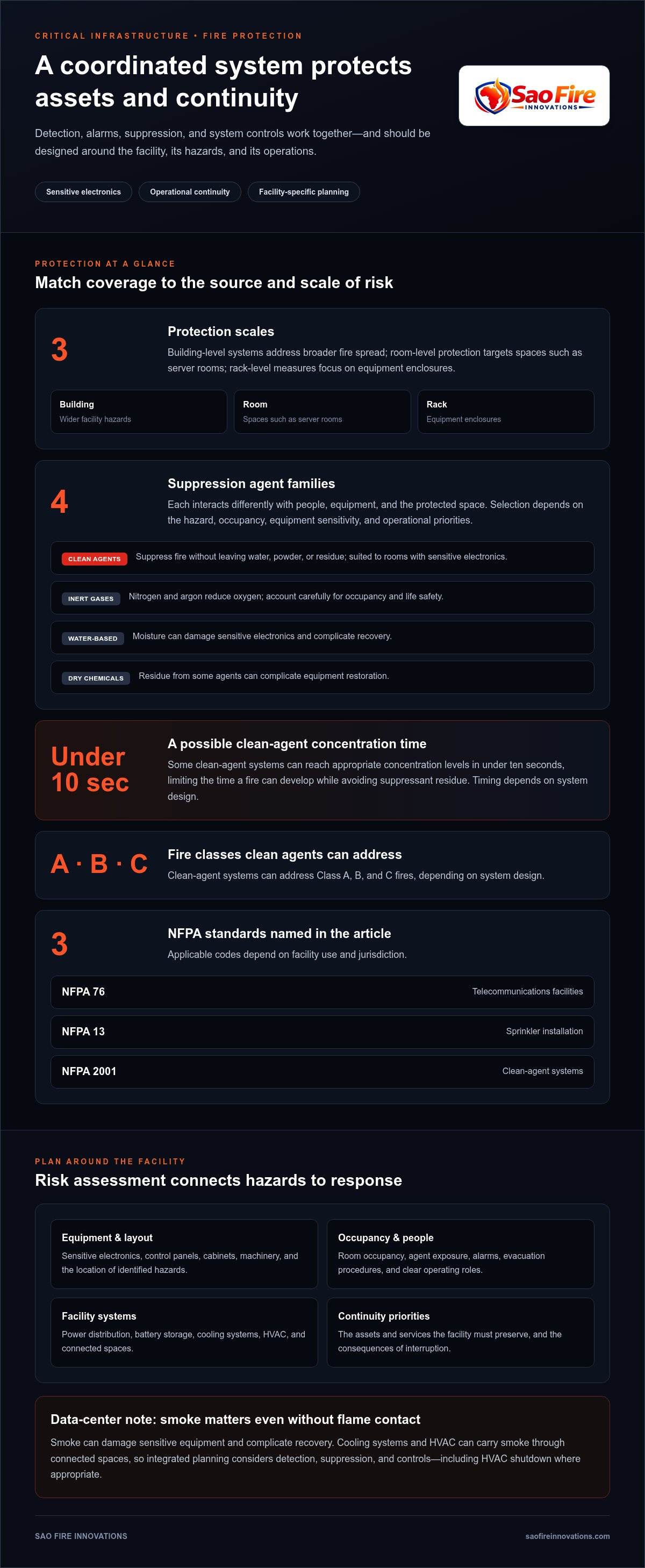
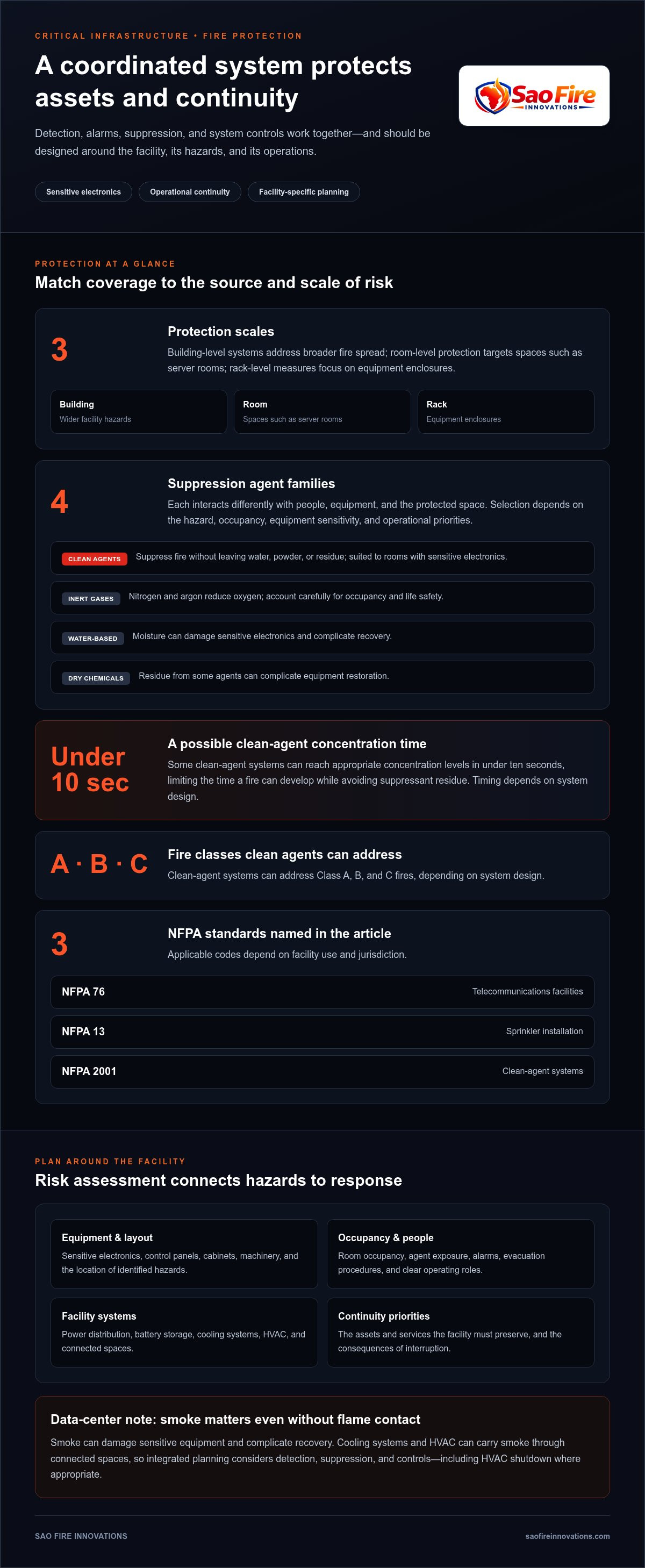
Building-level systems address broader facility hazards, room-level protection targets spaces such as server rooms, and rack-level measures focus on equipment enclosures. Each scale serves a different purpose. A building system can address wider fire spread, while room- or rack-level protection can target an incident closer to its source. Coordinating these layers helps align coverage with asset location and operational importance.
Facility-Specific Protection Planning
Facility-specific planning matches protection to layout, equipment, occupancy, power distribution, battery storage, cooling systems, and continuity needs. These factors shape where detection and suppression can be most effective. The European Union identifies the Critical Entities Resilience Directive as EU Directive 2022/2557. For operators, resilience planning connects physical safeguards with the services and assets a facility must preserve.
Suppression Systems, Standards, and Costs
System design combines hazard assessment, equipment selection, installation, testing, and commissioning. NFPA 76 addresses telecommunications facilities, NFPA 13 covers sprinkler installation, and NFPA 2001 addresses clean-agent systems; applicable codes depend on facility use and jurisdiction. Installation and maintenance costs depend on the protected spaces, chosen system, integration, and inspection needs. For design, installation, testing, and commissioning, assess hazards, select and install the system, then test its operation and document readiness.
What suppression agent is safest for sensitive electronics?
No single agent suits every electronics environment. Selection depends on the fire hazard, room occupancy, equipment sensitivity, and operational priorities.
Suppression Agent Types
Suppression agents include clean agents, inert gases, water-based systems, and dry chemicals; each interacts differently with people, equipment, and the protected space. That difference matters in electrical rooms, where residue or moisture can complicate recovery. Inert gases such as nitrogen and argon suppress fire by reducing oxygen, so designers must account for occupied spaces. NFPA 2001 addresses clean-agent systems, including inert-gas and halocarbon alternatives.
Clean Agents for Electronics
Clean-agent suppression controls fire without leaving water, powder, or residue, making it suited to rooms containing sensitive electronics. FK-5-1-12 is a clean agent designed to suppress fire quickly without residue. Clean-agent systems can address Class A, B, and C fires, depending on system design. Some can reach appropriate concentration levels in under ten seconds, limiting the time fire can develop while protecting equipment from suppressant residue.
Automatic operation can connect detection with discharge, while integrated fire controls coordinate the response. The system still needs to match the hazard, enclosure, and personnel occupancy. Clean agents do not make every incident harmless: the fire, discharge, and response can each affect operations.
Risks to People, Equipment, and Operations
System risks include agent exposure, equipment compatibility, and disruption during discharge or recovery. Oxygen-displacing inert gases can pose risks in normally occupied spaces, so their use requires careful consideration of occupancy and life safety. Water can damage sensitive electronics, while residue from other agents can complicate equipment restoration. Personnel response matters too: alarms, evacuation procedures, and clear operating roles help coordinate action during discharge.
For electronics environments, compare the hazard, occupancy, and potential equipment impact before selecting an agent. A total-loss-minimization approach can also inform how suppression decisions account for asset preservation alongside fire control. Explore Total Loss Minimization fire suppression technology as part of that broader perspective.
Fire hazards in data centers
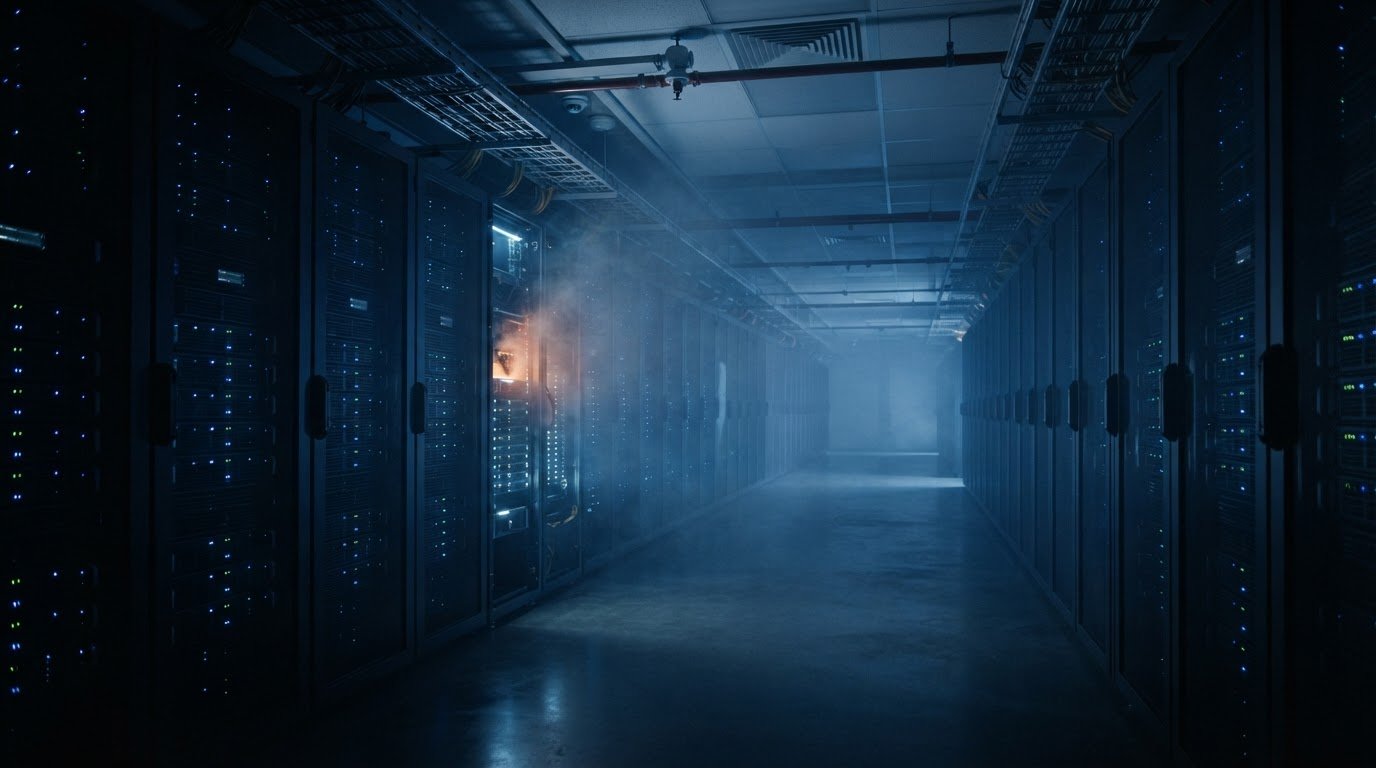
Data centers operate 24 hours a day, so an incident can threaten both equipment and uninterrupted service. Electrical faults, overloaded components, and damaged connections can create ignition risks inside server racks or power-distribution equipment. In dense environments, heat and smoke can move beyond the point of origin, reaching adjacent cabinets and shared infrastructure before personnel identify the source.
Smoke creates a distinct threat. It can damage sensitive equipment even when flames do not reach it, and contamination can complicate recovery across a server room. Air movement adds complexity: cooling systems and HVAC equipment can carry smoke through connected spaces. Integrated fire-safety planning therefore considers detection, suppression, and controls to limit smoke movement, including HVAC shutdown where appropriate.
Battery storage adds a planning concern because its location, equipment, and role in backup power affect the facility’s risk profile. Power distribution and cooling systems also need specific attention. A fault in one system can affect the systems needed to maintain safe operating conditions, while damage to shared equipment can extend downtime beyond the original room or rack.
Human response affects how quickly a developing hazard receives attention. An alarm that personnel misinterpret, a blocked cabinet, or unclear responsibilities can delay action. Training should define how staff recognize alarms, follow evacuation procedures, and communicate with emergency responders. Documented inspection and maintenance help teams identify system faults before an incident requires immediate action.
Effective data-center planning maps hazards against facility layout, occupancy, equipment, and business-continuity priorities. Teams can identify power rooms, battery areas, cooling equipment, and server cabinets, then assess how smoke or fire could spread between them. Detection, alarms, targeted suppression, and sprinklers where appropriate form a coordinated strategy. Regular tests and clear response procedures help confirm that each system performs its intended role without overlooking operational consequences.
What fire suppression systems are used in critical infrastructure facilities?
Critical facilities combine detection and suppression systems selected for their hazards, equipment, occupancy, and operational priorities. Integrated design coordinates these systems so detection can guide a targeted response.
Air-sampling detection continuously checks air for smoke particles, helping identify a developing fire before flames spread. In telecommunications equipment areas larger than 2,500 square feet, NFPA 76 requires Very Early Warning Fire Detection systems. Areas below 2,500 square feet require Early Warning Fire Detection. Detection can also trigger controls, such as shutting down HVAC equipment to limit smoke movement.
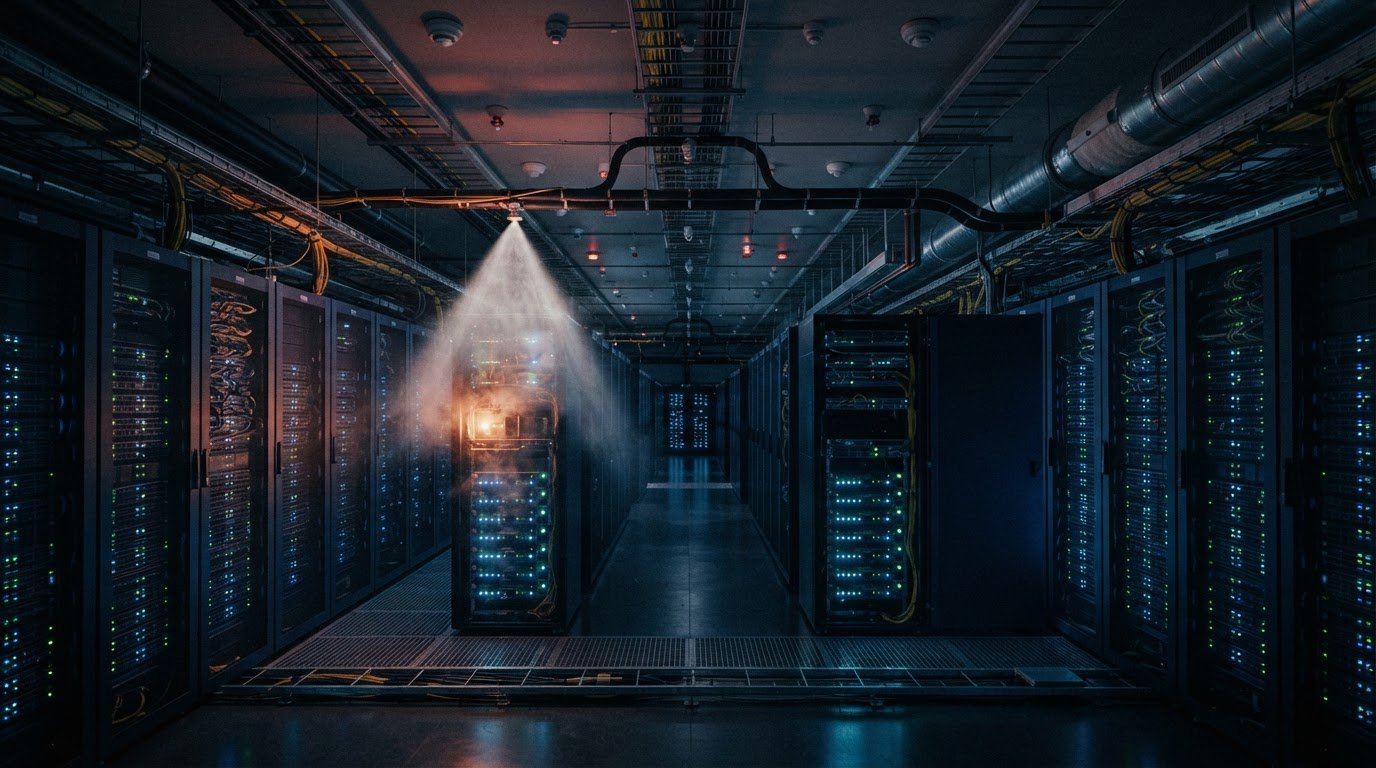
Clean-agent systems suit spaces where water or residue could damage equipment. They suppress fires without leaving water, powder, or residue. Inert-gas systems use gases such as nitrogen or argon to reduce oxygen to a level that cannot sustain combustion, so occupancy and life safety shape their application.
Water-based systems remain relevant where controlling fire and protecting life take priority. Standard sprinklers release water when heat activates a fusible element in a sprinkler head. Pre-action sprinklers add a detection step: a double-interlock design requires both a detection signal and physical sprinkler activation before water enters the piping. NFPA 13 covers sprinkler installation, while NFPA 750 addresses water mist systems.
Other hazards call for different approaches. Compressed-air foam can suppress flammable-liquid fires and limit vapor release. Deluge systems can address power-generation environments where coal dust creates an additional concern. Modular units can operate independently or as part of a larger integrated system, depending on the protected equipment and facility design.
Selection starts by matching detection and suppression to the fire scenario, occupancy, and potential impact on operations. NFPA 2001 addresses clean-agent systems, while NFPA 76 guides protection in telecommunications facilities. For a system designed around asset preservation as well as fire control, explore Total Loss Minimization fire suppression technology.
SAO Fire Innovations: Total Loss Minimization fire suppression technology
SAO Fire Innovations is developing Total Loss Minimization fire-suppression technology for organizations seeking to limit asset loss when fire threatens critical operations. The approach goes beyond extinguishing flames: it focuses on preserving valuable assets and supporting continuity after an incident.
The technology is being developed for infrastructure leaders assessing how suppression decisions affect equipment, operations, and recovery priorities. Research, prototyping, and testing are underway, focused on minimizing total loss. It complements the planning principles discussed above by keeping asset preservation in view alongside fire control, without replacing facility-specific hazard assessment or applicable fire-safety requirements.
To learn more about Total Loss Minimization fire-suppression technology, contact SAO Fire Innovations or visit saofireinnovations.com.
Make Resilience a Deliberate Design Priority
Protection decisions shape more than the response to a fire. They influence how an organization prioritizes asset recovery, operational dependencies, and long-term resilience. Treat fire suppression for critical infrastructure as part of continuity planning, with clear ownership across engineering, operations, and risk leadership. That alignment helps teams make protection decisions based on the services and assets they are responsible for sustaining.
For organizations exploring suppression with asset preservation in focus, SAO Fire Innovations offers Total Loss Minimization fire suppression technology. It provides a forward-looking perspective for infrastructure leaders assessing how to reduce the consequences of fire alongside the need to control it.
Explore the approach and its relevance to your infrastructure priorities by contacting SAO Fire Innovations. A considered next step can help your team advance a more resilient protection strategy.
Frequently Asked Questions
How does integrated fire protection work?
Integrated fire protection links detection, alarms, suppression, building controls, and staff response in one coordinated sequence. For example, an air-sampling detector can identify smoke, signal the control panel, and trigger HVAC shutdown to limit movement through connected spaces. The system then activates the selected suppression response while personnel follow established procedures. Coordination helps prevent separate systems from acting without regard for one another.
What makes automatic activation systems reliable?
Reliable automatic activation depends on suitable detection, correct system configuration, and documented inspection and testing. Self-contained activation mechanisms can operate independently of external power sources or building management systems, reducing reliance on those connections. Reliability also depends on clear discharge paths, functioning controls, and the enclosure conditions required by the chosen agent. Testing should confirm that detection signals and suppression components perform their intended roles.
What is the purpose of a fire suppression system?
A fire-suppression system controls or extinguishes a fire to protect people, limit fire spread, and reduce damage to buildings and assets. It can also support continuity by limiting disruption to essential operations. Suppression is part of a broader fire-safety strategy, not a replacement for detection, alarms, evacuation procedures, or emergency response. System design should reflect the hazard and the consequences of interruption.
How do water mist, inert gas, clean agent, and sprinkler systems compare for critical infrastructure?
These systems differ in how they suppress fire and what they leave behind. Sprinklers use water and can contain fires, but water may harm sensitive electronics. Water mist is a distinct water-based option. Clean agents suppress fire without water, powder, or residue. Inert gases such as nitrogen and argon reduce oxygen, making occupancy a key consideration. Compare the hazard, equipment, room use, and recovery priorities before choosing.
Which fire suppression systems are best for data centers, power plants, telecom facilities, and water utilities?
No single system fits every facility. Data centers may combine early smoke detection with clean agents and sprinklers where appropriate. Power plants need protection matched to their processes, such as deluge arrangements in coal-dust environments. Telecommunications facilities benefit from coordinated detection and suppression. Water utilities should assess control rooms, electrical equipment, occupancy, and site-specific hazards before selecting protection, rather than applying a data-center design unchanged.
How should facilities assess fire hazards and choose a suppression system?
Start by mapping ignition sources, combustible materials, occupied areas, and critical equipment across the facility. Then assess how smoke, heat, or suppressant discharge could affect adjacent operations and recovery. Compare those findings with applicable codes, system inspection needs, and continuity priorities. This structured assessment gives fire suppression for critical infrastructure a site-specific basis, helping teams match detection and suppression to actual hazards rather than assumptions.
Frequently Asked Questions
Integrated fire protection links detection, alarms, suppression, building controls, and staff response in one coordinated sequence. For example, an air-sampling detector can identify smoke, signal the control panel, and trigger HVAC shutdown to limit movement through connected spaces. The system then activates the selected suppression response while personnel follow established procedures. Coordination helps prevent separate systems from acting without regard for one another.
Reliable automatic activation depends on suitable detection, correct system configuration, and documented inspection and testing. Self-contained activation mechanisms can operate independently of external power sources or building management systems, reducing reliance on those connections. Reliability also depends on clear discharge paths, functioning controls, and the enclosure conditions required by the chosen agent. Testing should confirm that detection signals and suppression components perform their intended roles.
A fire-suppression system controls or extinguishes a fire to protect people, limit fire spread, and reduce damage to buildings and assets. It can also support continuity by limiting disruption to essential operations. Suppression is part of a broader fire-safety strategy, not a replacement for detection, alarms, evacuation procedures, or emergency response. System design should reflect the hazard and the consequences of interruption.
These systems differ in how they suppress fire and what they leave behind. Sprinklers use water and can contain fires, but water may harm sensitive electronics. Water mist is a distinct water-based option. Clean agents suppress fire without water, powder, or residue. Inert gases such as nitrogen and argon reduce oxygen, making occupancy a key consideration. Compare the hazard, equipment, room use, and recovery priorities before choosing.
No single system fits every facility. Data centers may combine early smoke detection with clean agents and sprinklers where appropriate. Power plants need protection matched to their processes, such as deluge arrangements in coal-dust environments. Telecommunications facilities benefit from coordinated detection and suppression. Water utilities should assess control rooms, electrical equipment, occupancy, and site-specific hazards before selecting protection, rather than applying a data-center design unchanged.
Start by mapping ignition sources, combustible materials, occupied areas, and critical equipment across the facility. Then assess how smoke, heat, or suppressant discharge could affect adjacent operations and recovery. Compare those findings with applicable codes, system inspection needs, and continuity priorities. This structured assessment gives fire suppression for critical infrastructure a site-specific basis, helping teams match detection and suppression to actual hazards rather than assumptions.