
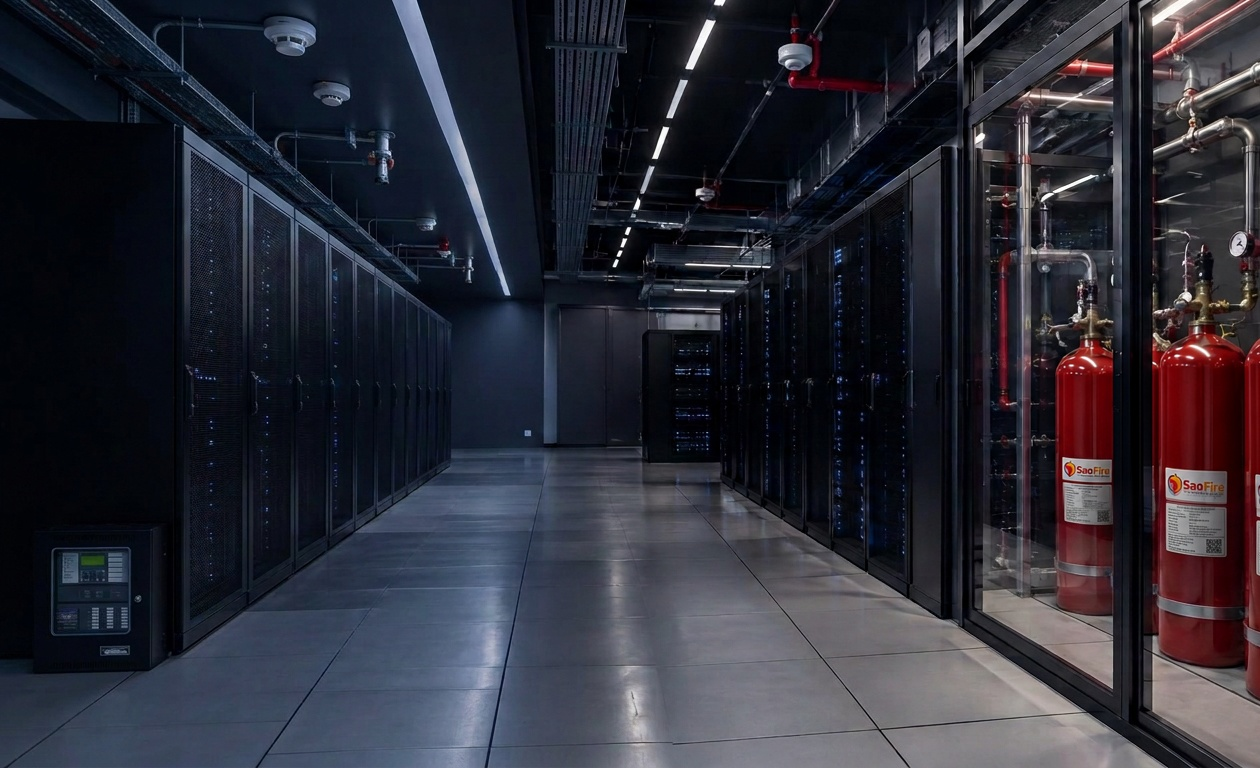
Fire Suppression Explained
What is clean agent fire suppression?
Clean agent fire suppression extinguishes fire without water, foam or powder and without the residue that destroys the very assets the system was installed to protect. It is the approach built for environments where the cost of the wrong extinguisher is higher than the cost of the fire.
The Problem With Conventional Suppression
The fire is not always the biggest loss.
Conventional suppression was designed to save the building. But in a data centre, an archive, a forensic laboratory or a control room, the building is rarely the most valuable thing in it.
Water
Effective on flames, catastrophic on electronics, paper, evidence and precision equipment. Water damage frequently exceeds fire damage in high-value environments.
Foam
Designed for flammable liquid fires, foam contaminates everything it touches and demands extensive cleanup before operations can resume.
Dry powder
Abrasive, corrosive and nearly impossible to fully remove from circuitry and machinery. Powder discharge can write off equipment the fire never reached.
How Clean Agents Work
Extinguishing fire at the molecular level.
Interrupting the fire triangle
Fire needs heat, fuel and oxygen. Clean agents extinguish by removing heat, disrupting the chemical chain reaction of combustion, or reducing oxygen to a level where fire cannot sustain itself while remaining safe for occupied spaces when correctly designed.
No residue, no cleanup
Unlike water, foam or dry powder, a true clean agent evaporates or dissipates after discharge. There is no corrosive slurry in a server rack, no soaked archive, no powder baked onto circuit boards the agent leaves nothing behind.
Seconds, not hours
Clean agent systems are engineered to reach extinguishing concentration in seconds. The faster a fire is suppressed at its source, the smaller the total loss in damage, downtime and recovery cost.
Where It Is Used
Built for environments where loss is measured in more than flames.
Clean agent suppression is the standard approach wherever the protected asset is irreplaceable, mission-critical or worth far more than the space that holds it.
- Data centres and server rooms
- Telecommunications facilities
- Museums, archives and libraries
- Forensic and evidence laboratories
- Financial institutions and records vaults
- Medical and imaging facilities
- Industrial control rooms
- Aviation and marine applications
Common Questions
What people ask about clean agent suppression.
What is a clean agent fire suppression system?
It is a fire suppression system that uses an electrically non-conductive, volatile or gaseous extinguishing agent that leaves no residue after discharge. The agent suppresses fire without damaging the equipment, documents or materials it protects.
Do clean agents leave residue?
No. That is the defining characteristic. Water ruins electronics and paper; foam contaminates surfaces; dry powder is abrasive and corrosive. Clean agents evaporate or dissipate, leaving protected assets intact and operations recoverable.
Why does residue matter so much?
Because in high-value environments the suppression agent itself can cause more loss than the fire. A small electrical fire in a data centre, extinguished with water, can destroy an entire row of servers. The true cost of a fire is the total loss not just what burned.
Where is clean agent suppression the right choice?
Anywhere the protected asset is worth more than the room around it: data centres, archives, forensic evidence stores, control rooms, medical facilities and other critical infrastructure where downtime and contamination are unacceptable.
This is the philosophy behind SAO Fire.
SAO Fire Innovations is developing a first of its kind suppression solution built around Total Loss Minimization the principle that success is not only a fire put out, but the smallest possible total loss across people, assets, equipment, infrastructure and critical materials. Clean agent thinking is where that principle begins.